On sale since early last year, the Volkswagen ID.7 range is now completed with the Tourer estate model, and the fastest GTX versions. So, we jumped at the chance to spend a longer period with the fastest version of the Volkswagen ID.7 Tourer.
Design and interior
ID.7 models are becoming more popular now, but you don’t see many Tourer estate versions, even less in the sportiest GTX spec that we have here. In terms of styling, in our opinion, the Tourer is the pick of the range. On top of the increased loadspace from 532 litres to 605 litres, the smooth hatchback design makes an even sleeker, more attractive estate. Identified by the sharply styled lights and light bar, the GTX makeover consists of a new bumper, chunkier side skirts, and on our test car, optional 21in alloy wheels which filled this Volkswagen’s arches, helping it to stand out from a standard version.
We like the ID.7’s interior, but even after the GTX makeover, would question whether enough has been done to differentiate it from standard? The red highlights on the dashboard, seats, and steering wheel are welcome. With the leatherette and suede-look trim on the sports seats, the subtle GTX badging on the seats and steering wheel – we still think Volkswagen could have gone further. Drivers will again appreciate the fact that the key touchpoints, such as the top of the dashboard, door cards and centre console are finished in soft-touch plastics – although considering the car’s £60,000+ price, we feel some should be softer still.
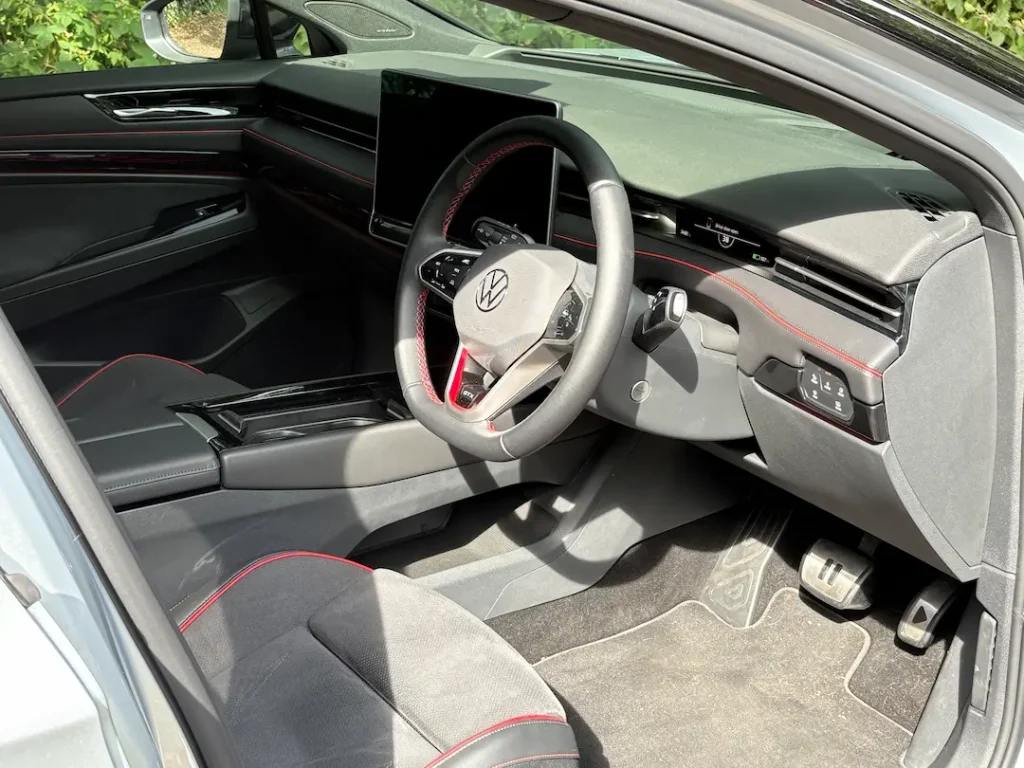
The ID.7’s lower driving position, plus the seats, impress. Volkswagen’s previous infotainment has come in for considerable criticism, so it’s good to report that the standard 15in touchscreen is thankfully now fitted with backlit bottom sliders, plus more customisable functions, and moving with the times, the tile home screen and online voice assistant work with ChatGPT. The Tavascan made by VW Group brand Cupra has a smaller screen, and we wonder if the ID.7 really needs such a big infotainment screen? There are also too many menus, which can make some key functions such as the heating and ventilation more difficult to use on the move. In general, it’s simple to operate (thankfully!), and the head-up display is welcome, as it’s easy to read.
Space is almost limo-like in the back of the ID.7 – the flat floor adds to the comfort, too. Then there’s the 605-litre boot, with its more upright opening. If you need more room, the seats fold giving 1,714 litres of almost flat boot space.
Performance and drive
Underneath, the ID.7 might share its MEB modular electric drive platform with the ID.3 and ID.4, but in GTX form, this Volkswagen EV gets more power with the same 86kWh battery. The electric motor now produces 335hp, 560Nm, and 0-62mph in 5.4 seconds. Most important is that the ID.7 GTX Tourer is still capable of up to 365 miles of range.
When it’s time to charge, like all ID.7s, the GTX can take DC charging up to 175kW, which is good enough to equal a 10-80% charge in under 30 minutes.
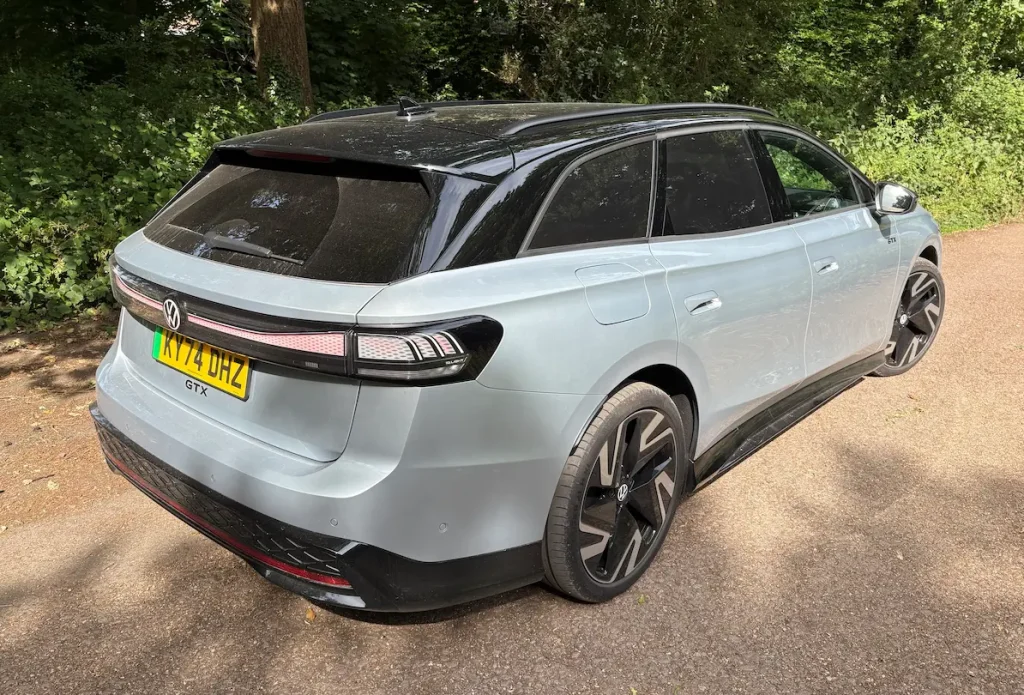
On the road, as with previous GTX models we’ve driven, this ID.7 is more about the extra performance than any more driver involvement, or sportiness. This is not to say this Volkswagen drives badly. In fact, dynamic changes such as the thicker anti-rollbars and the standard, tuneable DCC suspension mean you can attack the corners harder than with the standard car. The steering felt sharper too, but like with the standard car, it lacks feel. DCC or not, the ride on the optional 21in wheels was inconsistent, and at its worst at low speeds. The ID.7 GTX is more of a high-speed cruiser and is better driven this way. We also didn’t like the brake feel of this Volkswagen either, as they proved hard to modulate. The Audi A6 E-Tron Avant or BMW i5 Touring are more fun alternatives to drive.
The ID.7 remains the best EV from Volkswagen yet, but in GTX form, we feel Volkswagen could have gone further, as it lacks the driver appeal of other premium rivals.
Positive: Looks great, good to drive although not sporty, comfortable, well-equipped interior, impressive boot capacity.
Negative: GTX changes could have gone further, brisk rather than sporty performance, range and efficiency could be better, pricey.
Standard equipment: 15in infotainment display, augmented reality head-up display, IQ.Light LED matrix headlights, front/rear parking sensors with a 360-degree camera, heated front seats, heated steering wheel, tri-zone automatic climate control, 19in alloy wheels, climate windscreen.
Engines: Electric: 282hp, 335hp
Equipment grades: Pro Match Plus, Pro S Match Plus, GTX Plus 4Motion
Transmission: Single-speed automatic
| Model | Volkswagen ID.7 GTX Plus 4Motion 86kWh |
| P11D | £59,900 |
| Residual value | 54% |
| Depreciation | £27,562 |
| Fuel | £3,720 |
| Service, maintenance and repair | £3,018 |
| Cost per mile | 57.16p |
| Range | 365 miles |
| CO2 (BIK%) | 0g/km (3%) |
| BIK 20/40% a month | £30/£60 |
| Luggage capacity | 605 litres |
| Battery size/power | 86kWh/335hp |
| Score | 7/10 |