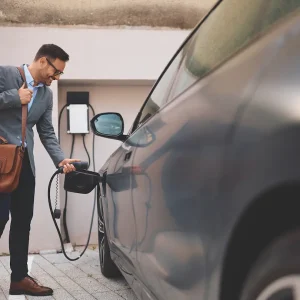
The journey towards fleet electrification presents huge opportunities for businesses – whether to reduce their tailpipe emissions or win new business contracts from customers increasingly focused on sustainability. It will, however, also introduce new challenges for fleet managers to navigate, and add new responsibilities to their role.
Before exploring what the transition means for fleets, let’s look at what may happen in the years to come. BP’s Energy Outlook, which explores the key trends surrounding the energy transition, predicts that by 2035, EVs will account for 20-30% of light duty vehicles globally, though with a much higher proportion in developed markets. This means that for the foreseeable future, many fleet managers will have to manage a mix of conventional fuel and electric vehicles.
The changing nature of fleet management
Managing a mixed fleet has fundamentally transformed the role of fleet managers. Where once their remit focused primarily on hiring drivers, purchasing vehicles and overseeing maintenance schedules, today’s fleet managers wear multiple hats.
Alongside all their existing responsibilities managing conventional petrol and diesel vehicles, they now also have to play the role of property managers when considering EV charging infrastructure at their sites; HR, when helping drivers to manage operational issues like reimbursement for home charging; and data analysts, when delving into complex route and mobility patterns to understand where to introduce new vehicles.
Many fleet operators install EV charging at their sites as a key part of their transition strategy. But the cost and complexity of deploying multiple chargers makes getting it right the first time very important. Managers must determine optimal charger quantity, speed, and assess site power requirements. They must also consider their sites’ overall longevity – installations may not be viable at a site if it only has a short lease remaining. Charging-as-a-service options can address some challenges, but EV infrastructure undeniably adds complexity to fleet management responsibilities.
Beyond handling issues around the actual installation of charging infrastructure, fleet managers need to help drivers adapt to a new way of operating. While they might still be able to just hand over the keys to a petrol or diesel vehicle, putting drivers in EVs requires a more hands-on approach. It’s important to ensure drivers understand where, when and how to charge, and concepts like charging curves. Operators may also need to offer drivers home charging options, though this adds complexity as drivers would likely need to own their home with off-street parking. Thorough training must also clarify that expense claims can only be made for charging work vehicles.
Data has become an essential tool for operators to succeed in navigating the transition. While managers have long used data to evaluate the efficiency of their conventional fleets, data is at the heart of a successful transition to EVs. Gathering insight into mobility patterns, route optimisation, mileage tracking, and charging infrastructure usage are all vital to determine which vehicles within the fleet can be electrified. This will also help to clarify the infrastructure investments that make sense at specific locations, and how charging requirements might influence operational efficiency.
Beyond operational challenges, the transition also brings new administrative considerations. Operators managing mixed fleets may have to grapple with multiple invoices, reimbursement models for home charging, and complex reporting systems. The administrative burden can be challenging, particularly for smaller fleets which may not have the resource to manage both the process of transitioning to EVs, and the day job of ensuring the fleet is operating efficiently.
Looking ahead, it’s clear that mixed fleets will remain common for years to come. Fleet managers are increasingly looking for solutions to help them manage the transition; whether that is payment tools that reduce the admin burden and cover both conventional fuels and electric charging, intelligent fleet management platforms that enable smarter decision making, or innovative infrastructure financing options like charging-as-a-service. By adapting their operations and implementing strategies specifically designed for mixed fleet management, fleet managers can navigate the electrification journey more effectively, minimising operational disruption and keeping their fleets on the road.
Adrian Brabazon is head of BP Fleet Solutions