The Lexus RZ was launched in 2023, and quickly established itself as a practical, comfortable, and refined EV, that was good to drive. However, the first dual-motor versions weren’t that efficient, and as a result, rivals offered a more convincing range. Lexus went on to partially solve the range issue, by offering the RZ in single-motor 300e versions with smaller 18in wheels, which on our long-term fleet, equalled a regular range of almost 300 miles.
The highlights of this facelift are the introduction of the Lexus steer-by-wire system, that we tried at the original launch, and the addition of the range-topping RZ 550e F Sport, the first electric F Sport model in the Lexus range, which also debuts Lexus’s answer to the Hyundai Ioniq 5 N’s e-Shift simulated eight-speed dual-clutch transmission.
However, underneath these headline changes, the RZ’s battery electric powertrain has also been revised, with the focus on enhancing performance, practicality and driving pleasure. Key to this is the introduction of a new high-capacity lithium-ion battery and revised e-axles with improved electric motor output and inverter efficiency, and a significant reduction in internal losses. There is also a new 22kW onboard charger as standard, replacing the previous 11kW unit, equalling a 10-80% charge in just 30 minutes.
With all these changes, the RZ is available with three different power output options, beginning with the single-motor, front-wheel drive RZ 350e, with 224hp, a 7.5 second 0-62mph figure, and up to 352 miles of range (up from a 297 miles previously), if fitted with the smallest 18in wheels. Next up is the RZ 500e, with Direct4 four-wheel drive, 381hp, a 4.6 second 0-62mph acceleration figure, and up to 311 miles of range (up from the previous 450e’s 273-mile range). Lastly, there’s the range-topping RZ 550e, also with Direct4 four-wheel drive, with power up to 408hp, a 0-62mph acceleration time of 4.4 seconds, and up to 280 miles of range.
The key reason for these range efficiencies is the new 77kWh battery pack, which benefits from a new water-cooling system that helps maximise output and suppress cell deterioration, even under high-load conditions. This could include, for example, rapid charging after repeated or lengthy fast acceleration.
Design and interior
Outside there are new alloy wheel designs, but the biggest changes to the RZ exterior styling, can be seen in the new F Sport range-topper. At the front, there’s a new airdam with working airducts to cool the brakes, with the bottom fin-shape section designed to direct air flow down the side. Move to the back, and the most obvious addition is the rear spoiler, while there’s also a unique rear diffuser. Finally, the F Sport rides on 20in aero wheels.
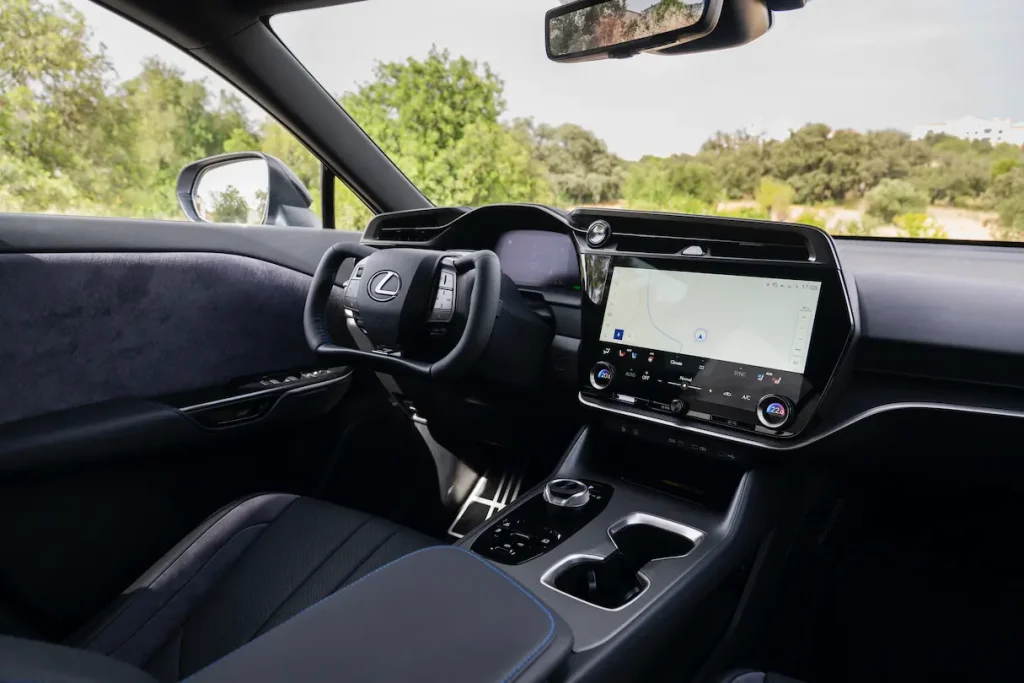
Inside, Lexus has created the first interior trim for the RZ that features graphics applied by laser to the Ultrasuede synthetic leather. Lexus has also extended the function of the 64-colour ambient light and shade, equalling moving patterns across the door panels, that are most obvious at night.
The infotainment is as before, with simple screen menus, featuring Apple and Android connectivity, but we still wonder why the drive modes are lost in one of these menus, making them hard to change on the move! Elsewhere, the switchgear is generally chunky and easy to operate. Although, considering the size of the infotainment screen, it’s a shame Lexus didn’t fit a bigger screen that completely fills the space in front of the steering wheel on the RZ 350e.
All RZ models have a comfortable driving position, and supportive seats. With a glass roof, that can be turned opaque at the touch of a button on the range-topping models, the interior feels airy. The quality too, as expected, is generally impressive, and gets more impressive the higher up the range you go. Rear legroom also impresses, and the 522-litre boot is practically shaped – it can be extended to 1,451 litres with the rear seats folded.
Performance and drive
We got the chance to drive all three versions of the updated RZ. The 350e in Exclusive spec was the first, and feels most suitable for fleet, with the biggest range, single motor, and the modest 18in wheels lost in arches. It is no sports car but feels sprightly off the mark. The handling is also tidy with plenty of grip. The 18in wheels equal more range but also more road noise.
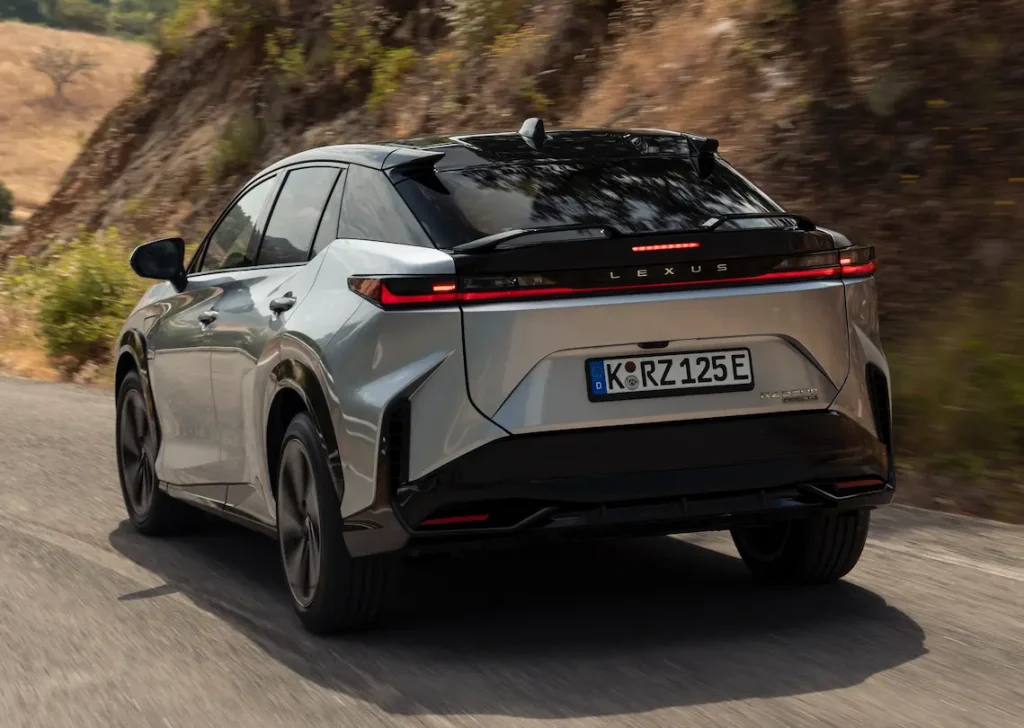
Next, we moved on to the RZ 500e, with the Direct4 four-wheel drive system. Surprisingly, the bigger 20in wheels are quieter, with seemingly no negative effect on the ride or handling – although you do take a hit on the range!
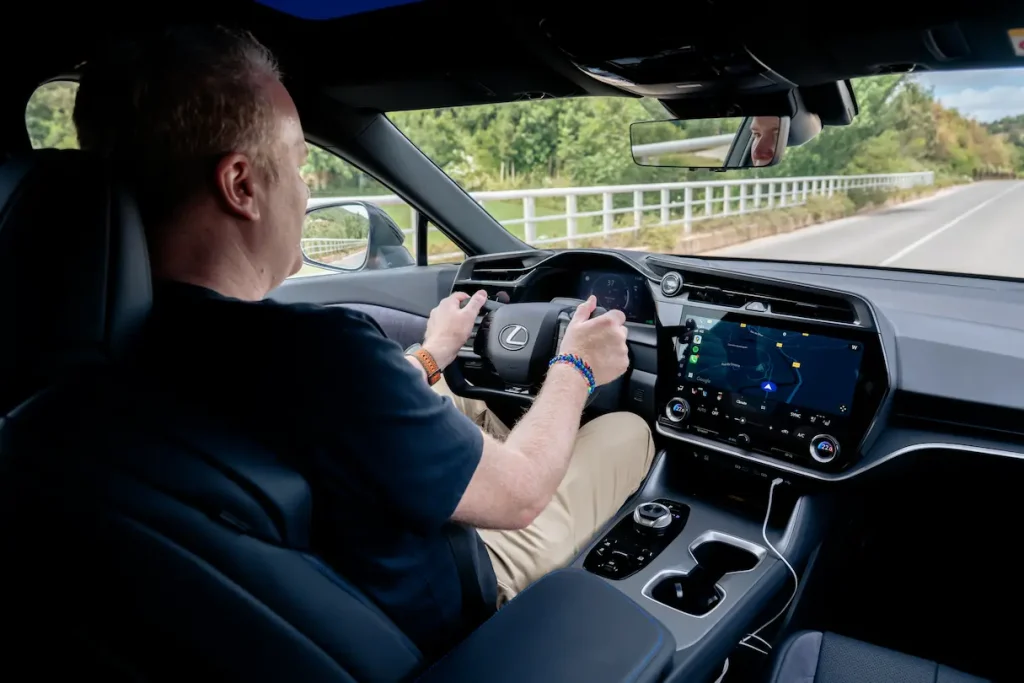
Finally, we drove the new range-topper, the RZ 550e in F Sport spec. Firstly, this RZ is fitted with the steer-by-wire system, and the simulated automatic transmission. As seen – and dumped – by Tesla with the Model S, the ‘yoke’ style steering wheel doesn’t appeal. However, Lexus seems to have refined how the ‘steer-by-wire’ system works in town, and at low speed, since our last drive – it feels much nimbler and sportier. Although, the fact that the column switchgear is smaller and moves with the ‘yoke’ is still a frustration, as the indicators aren’t always where you expect them to be. However, we’re sure drivers would get used to this.
The simulated dual-clutch automatic transmission also works well, giving another level of involvement in this Lexus’s drive. Although there’s no choice of engine note, which itself sounds a bit artificial, and drones after a while. It is a shame the F Sport version, with which it’s fitted as standard, is expected to account for just 15% of UK sales, so probably even less in fleet.
Question marks remain about the range, although all the RZs we drove seemed more efficient than before. Pricing was also not confirmed, and already the current Lexus RZ isn’t cheap. Alternatives such as the Skoda Enyaq and Hyundai Ioniq 5 are cheaper, but the Lexus still impresses with its quality interior and ICE-like feel to the ride and refinement.
Positive: Refined drive, attractive interior design and practicality, space, quality feel, drive-by-wire steering, simulated dual-clutch automatic transmission.
Negative: Likely to be even more expensive than before, lack of physical infotainment controls, yoke steering wheel will not appeal to all.
Standard equipment: 18in alloy/resin wheels, single-LED headlights, ambient interior lighting (one-colour), Panoramic View Monitor, synthetic leather upholstery, power-adjustable heated front seats, LexusLink multimedia with 14in display, 22kW on-board charger, Lexus Safety System+ active safety and driver assistance functions.
Engines: Electric: 224hp, 381hp, 408hp
Equipment grades: Exclusive, Luxury, F Sport
Transmission: Single-speed automatic
| Model | Lexus RZ 350e Exclusive |
| P11D | TBC |
| Residual value | TBC |
| Depreciation | TBC |
| Fuel | TBC |
| Service, maintenance and repair | TBC |
| Cost per mile | TBC |
| Range | 352 miles |
| CO2 (BIK%) | 0g/km (3%) |
| BIK 20/40% a month | TBC/TBC |
| Luggage capacity | 522 litres |
| Battery size/power | 77kWh/224hp |
| Score | 8/10 |