Electrification is still new to many manufacturers, yet with the Leaf, Nissan is an old hand. It has sold 290,000 examples of the model in Europe, and of these 71,000 have found homes in the UK across two generations and 15 years.
Now the Leaf is back for its third generation, this time as a sleek-looking SUV, boasting up to 386 miles of range, 150kW rapid charging, NissanConnect infotainment with Google built in, and vehicle-to-grid technology.
Design and interior
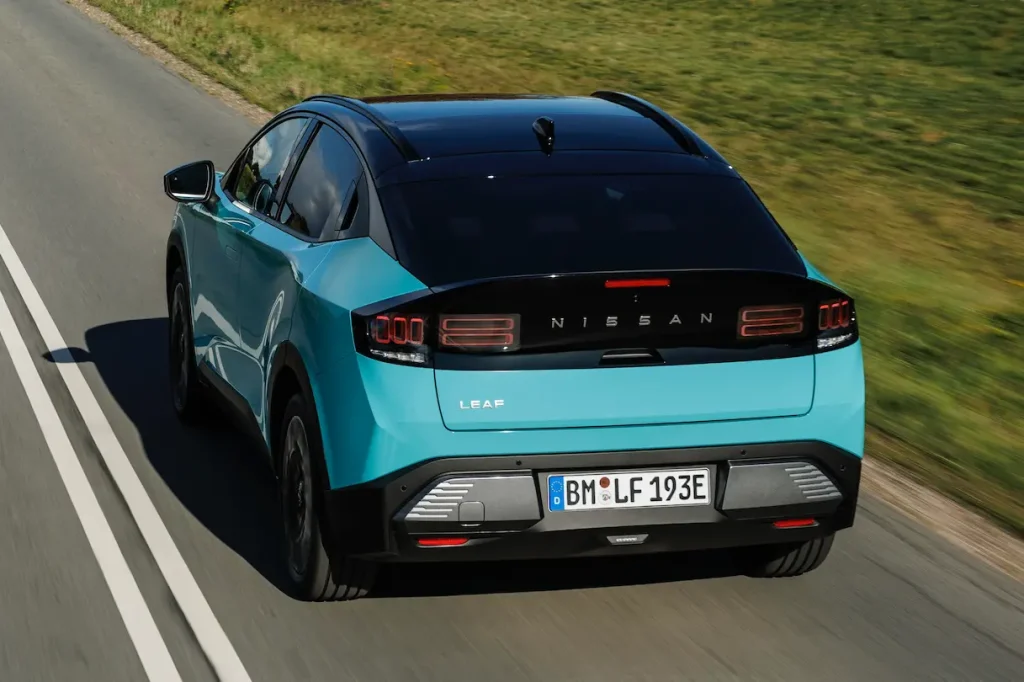
For the previous 15 years the Leaf has been a classic hatchback design, but for its third generation Nissan has given the Leaf’s styling a timely crossover rework. From the front, there’s the big and distinctive light signature that curves around the headlights and the aerodynamic colour-coded and sealed grille around the front of the car. The Leaf has bulked out and is longer – mostly thanks to the fact it’s now built on the same CMF-EV platform as the bigger Ariya. Design highlights include the curvy roofline, and the duck-tail spoiler made up of the dark rear light bar. The roof itself is made more interesting, as it’s finished in black, which contrasts well with the body colour. There are flush front and sporty hidden rear door handles, and up to 19in wheels on top versions.
We think the rear is the most distinctive part of the new Leaf’s design; it’s dominated by the contrasting black panel that has ‘Nissan’ badging spread across it and is lit up by the distinctive rear lights and their signature. The signature, made up of two lines and three parallel lines next to it, features throughout the Leaf. This is because the words for two and three in Japanese are ‘ni’ and ‘san’ – get it?
Overall, the Leaf’s design is best described as sleek and distinctive. It will make more of an impression than the old car.
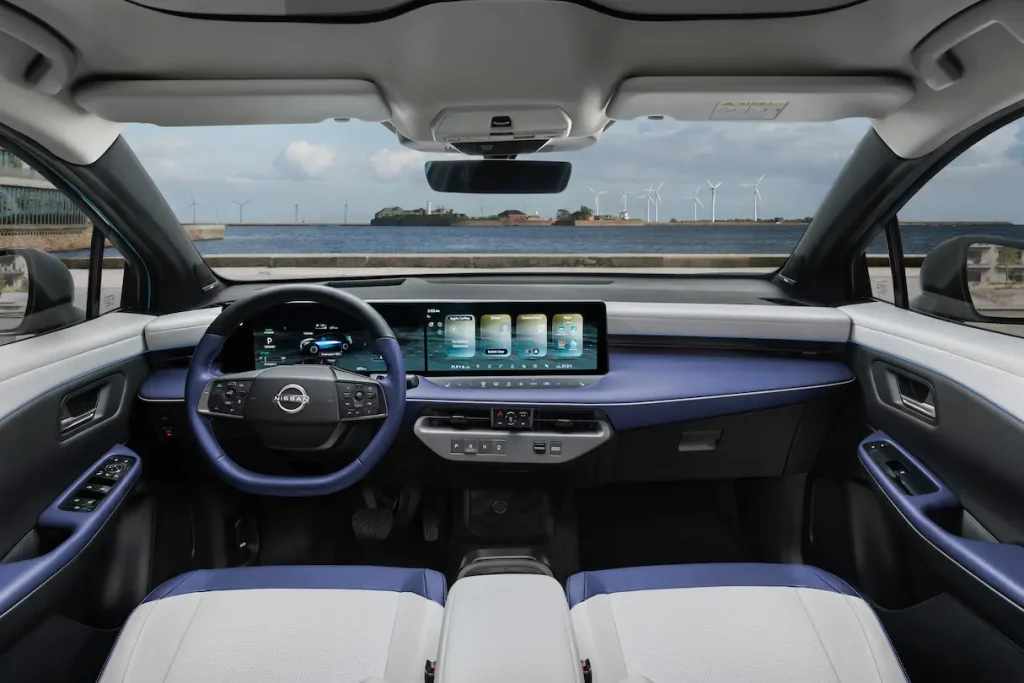
Inside, the highlights of the horizontally designed dashboard are the two 14.3in screens for the instruments and NissanConnect infotainment. The Google-based infotainment works the same as in the recently-driven Nissan Micra. It is easy to operate and works well – although sometimes the maps are hard to read. The fabric trim on the top of the doors, plus the lighter colours of our test car gave the interior of the Leaf a more premium feel than expected – as there’s plenty of hard plastic trim. However, on the flip side, you wonder how good the light trim will look after a couple of years and with dirty fingerprints!
The biggest surprise is the driving position, lower than rivals such as the Skoda Elroq, an EV favourite of ours. The front seats are also comfortable, although in our opinion, could do with more side support. Nissan is particularly proud of the Leaf’s panoramic glass roof, which has no traditional sun blind. Instead, it can be darkened in segments at the touch of a button. It certainly gives welcome added light to the cabin, even on cloudy Autumn days.
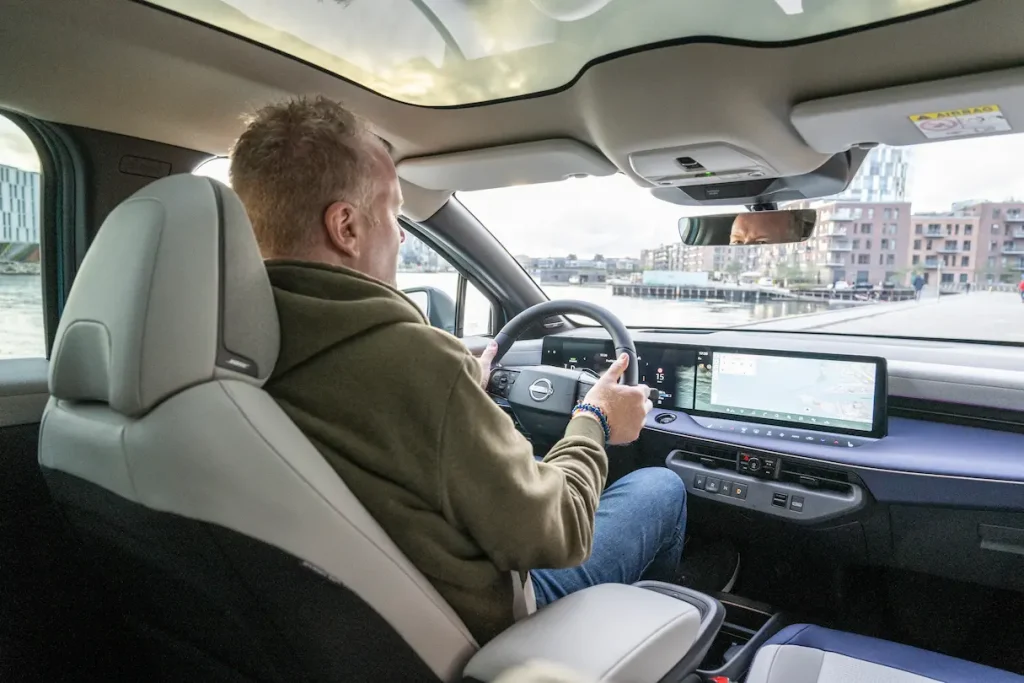
Less impressive is rear legroom in the Leaf – which is merely average, and that curvy roofline and glass roof eat into headroom. So, the tallest will be uncomfortable on longer trips. Boot space totals 437 litres, and there’s a useful adjustable floor. However, the load lip is high, and there are no other clever touches, such as a movable rear seats, to add to the practicality.
Performance and drive
The new Leaf is offered with two batteries – a 52kWh with an expected range of up to 271 miles, and the range-topping 75kWh that we drove, which has a WLTP range of 386 miles. There are two motor options, with 174hp or 215hp. When it comes to charging, all Leafs benefit from a standard-fit heat pump, and support 150kW (DC) charging.
We spent our time in the 215hp version, and it’s the comfortable and composed ride that impresses first, which Nissan claims is the result of the new CMF-EV platform. Then there’s the precise steering, which although not particularly sporty, is much nicer than the Volkswagen ID.3’s. Although this is partly down to how nice the slim two-spoke multi-function steering wheel is to hold. Thanks to the Leaf’s soft suspension set-up, there is some body roll, but grip levels are high. Just like the ride and handling, the performance is smooth rather than dramatic, and it is efficient. We saw 4.1miles/kWh on the test route.
Still, this Nissan’s relaxed demeanour means you can make the most of its welcome one-pedal drive mode, and the regen-controlling paddles on the back of the steering. There are drive modes, but the only ones that make any real difference to the drive are ‘Sport’, which mostly sharpens the throttle response, and ‘Eco’, which does the opposite.
Engage, Engage+, Advance, and Evolve (the version closest to what we drove) equipment grades are available. All are well equipped, and prices are expected to start from £33,000, for the 52kWh versions, rising to £36,000 for the biggest 75kWh battery versions. Summing up, the third-generation Nissan Leaf is a likeable, efficient, and refined EV, that doesn’t look like rivals – which is a good thing.
Positive: Smart looks, impressively refined ride and drive, decent efficiency, affordable.
Negative: Rear legroom only average, rear roofline compromises head room, unremarkable to drive.
Standard equipment: 8in infotainment display with Apple Carplay and Android Auto, six-speaker audio system, automatic emergency braking system with pedestrian detection, rear-view camera, e-Pedal regenerative braking.
Engines: Electric: 174hp, 215hp
Equipment grades: Engage, Engage+, Advance, Evolve
Transmission: Single-speed auto
| Model | Nissan Leaf 160kW Evolve |
| P11D | £36,000 (est) |
| Residual value | TBC |
| Depreciation | TBC |
| Fuel | £3,091 |
| Service, maintenance and repair | TBC |
| Cost per mile | TBC |
| Range | 386 miles |
| CO2 (BIK%) | 0g/km (3%) |
| BIK 20/40% a month | TBC/TBC |
| Luggage capacity | 437 litres |
| Battery size/power | 75kWh/215hp |
| Score | 8/10 |