3rd Report: It’s the little things
Having well-behaved kids on a long-distance journey certainly helps keep stress levels down. But no matter how angelic your little ones are, if you have cup holders that won’t hold cups, a glovebox that won’t fit gloves and phone connectivity that won’t connect, you might just end up pulling your hair out. It really is the little things that make a big difference when it comes to long distance driving – and I can confirm that the E-3008 does not disappoint in the cup, phone or glove arena. I’ve already mentioned it a few times in previous write-ups, but the availability of wireless Android Auto in the E-3008 is an absolute godsend. It just works, and it’s one less thing I have to think about. I can skip through Spotify tracks and reroute mid-journey via Google Maps in a flash.
I’m a fan of the simple steering wheel controls too. In essence, one side does audio, the other does cruise control. Very straightforward. A quick note on charging – there is a wireless charging pad which doubles up as a dedicated home for your phone, and there are also two USB-C charging ports in the front. These USB ports sit within a massive centre console storage space, which I’ve used to store everything from a jumbo Toblerone to multiple cameras and lenses – at the same time.
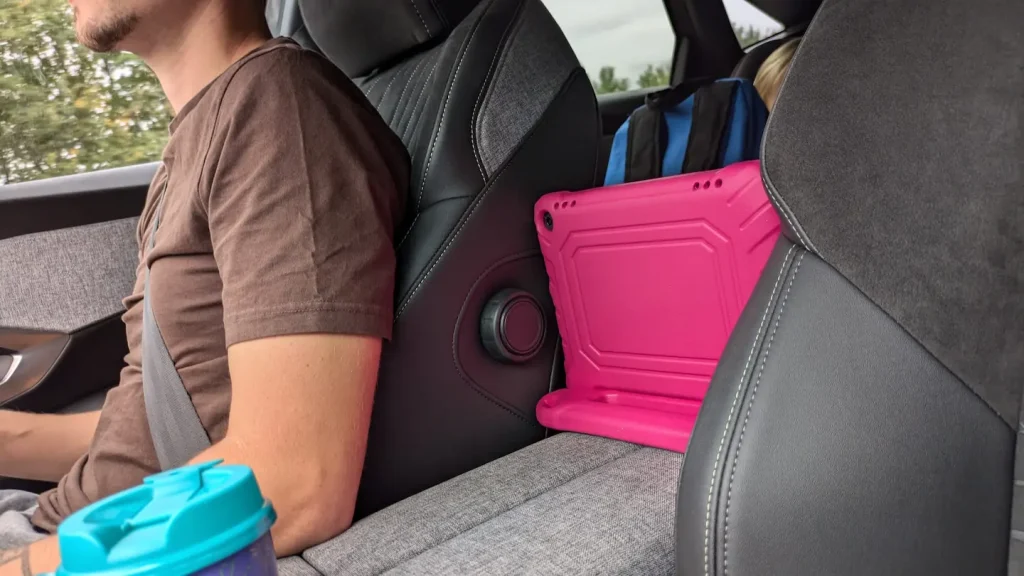
This can conveniently sit open for quick access or can be closed to hide valuables. You still get your usual under arm storage however, which is vast and has a funky bi-folding closure. When it comes to loading up on snacks and gadgets for long journeys, there isn’t much these two storage areas won’t accommodate. The deep and wide door bins help keep certain things easily to hand as well. While the glovebox in the E-3008 does suffer from the infamous French car fuse box clutter, the available space is enough to fit in travel essentials like baby wipes, spare nappies and a snack or two. A bonus feature of the aforementioned arm rest in the front is that it doubles up as a podium for mounting the kids’ tablet, or as a sweet station. It also sits above two rear-mounted USB-C charging ports, so the Bluey can keep on going.
As I sit typing this, I’m squashed between two child seats, with my laptop on my knee, pondering life as a passenger. Sitting beside two child seats in the E-3008 isn’t great, I’ll be honest – I’ve had happier hip experiences. But you do get loads of knee and head room at least, and the elevated seating position gives you a great view of the road ahead, reducing any feelings of claustrophobia.
My kids have been very happy with E-3008. The child seats have plenty of space in front of them, which not only makes them easy to fit and remove, but also makes jumping in and out of them simple for my kids.
The door bins in the rear aren’t as wide as the ones in the front, but they’re still deep enough for tall water bottles or a cache of sweets, and there is also a fold down arm rest with cup holders.
The windows in the rear are rather small, and feature privacy glass, which can make things a little gloomy. But those with kids will likely agree that it’s a worthy trade off in order to avoid the dreaded “the sun is in my eyes” cry.
One big win for the rear seats is the flat floor. Not only does it allow me to have my feet comfortably planted on the floor as I type this, but it lets me and my kids walk through the car from one side to the other, which is handy if we’re parked beside a busy road and want to hop across to the kerbside.
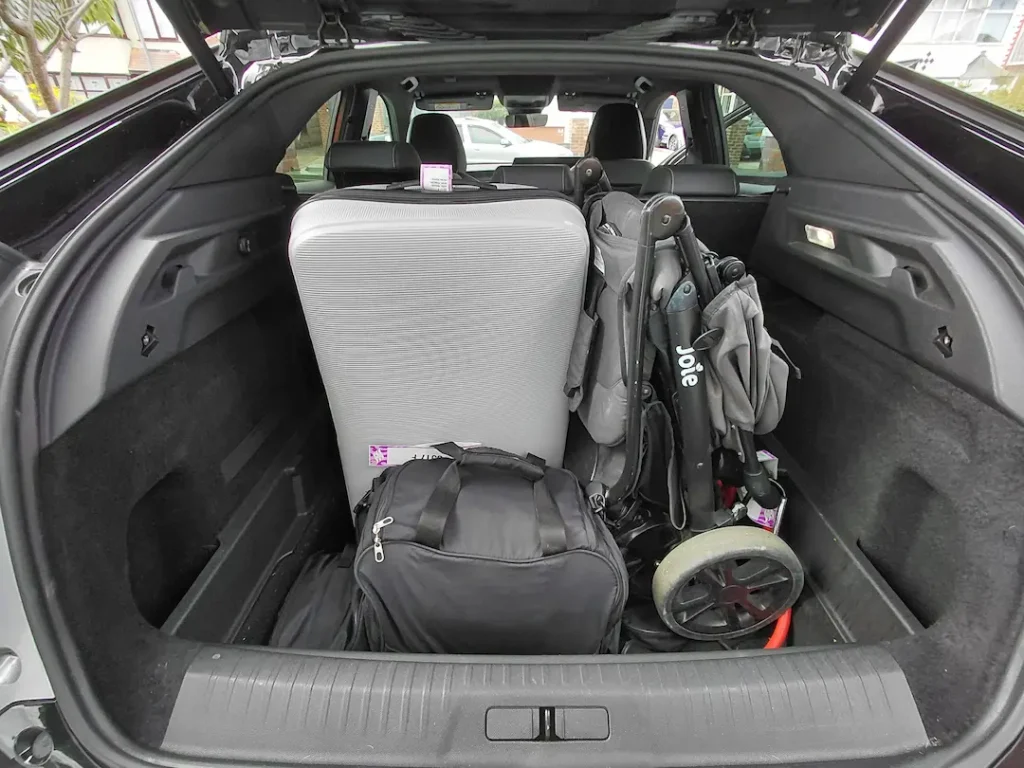
The boot in the E-3008 is perfectly adequate and there’s not much to say about it really. One noteworthy thing it does have however is a height-adjustable floor, which can actually be removed completely to allow for a cavernous amount of room – great for storing tall items like suitcases.
| Model | Peugeot E-3008 73kWh GT 210 |
| P11D price | £49,375 |
| As tested | £52,500 |
| Official WLTP range | 326 miles |
| Our average consumption | 4.2 miles/kWh |
| Mileage | 8,942 |
2nd Report: How accurate is the E-3008’s range?
It can be difficult to definitively say whether an electric car offers ‘accurate’ range. Firstly, what range figure are you considering? The WLTP combined range is what you’ll typically find stated on a spec sheet, but this can be dramatically optimistic at times. In fact, as a general rule of thumb, I tend to knock about 100 miles off a car’s combined WLTP figure, as this usually gives you a better idea of what you’ll get out on the road.
On the spec sheet for the Peugeot E-3008, its combined WLTP figure stands at 326 miles. So, imagine my surprise when I fully charged the E-3008 for the first time and saw exactly 326 miles on the clock. I was dubious, to say the least.
There are a helluva lot of elements that come into play when it comes to how accurate an EV’s range will be. On a basic level, you’ve got to consider how things like driving style, types of tires, battery age, weather conditions and luggage/passenger weight will affect said range.
Going a level deeper though, you’ve also got to consider how previous journeys could affect predicted range. Have you been driving like a maniac on country roads? If so, the car will likely calculate your predicted range to be much lower than it actually is.
There are also factors that are almost unquantifiable, like what if the car’s predicted range readout is reserving 15 miles or so to ensure you don’t run the battery down to zero and end up stranded – similarly to how conventionally-powered petrol and diesels give you a bit of leeway.
Based on all the criteria I just listed above, it’s safe to say that it’s incredibly difficult to predict whether an EV’s range is accurate or not. Rather than ‘accurate’, a more appropriate term would be ‘reliable’. Can you get behind the wheel and get to where you’re going without having an anxiety attack?
The best – and only – way to gauge that is to clock up some mileage and note down some figures, which is exactly what I did.
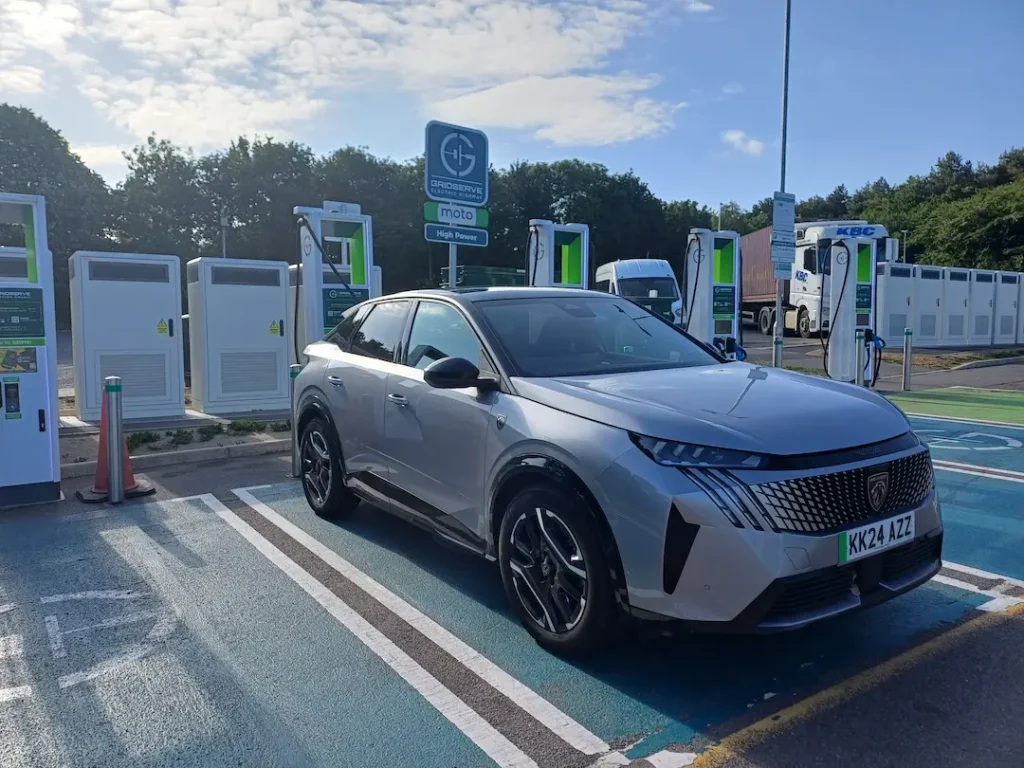
I’ve been doing a lot of motorway driving the past month, so all of the journeys I’m about to mention are primarily based on motorway driving at speeds of 50-70mph.
Based on several journeys of around 250-270 miles – and when setting off with a fully-charged battery – I found the E-3008’s range accuracy to be around 70-75%. That’s 50-80 miles off the mark, per journey.
I was initially a little disappointed with those figures. Determined to improve them, I had a play around with the car’s driving modes – and simply switching from Normal to Eco mode delivered some fairly significant results. Eco mode changes certain driving characteristics of the car to maximise efficiency – limiting things like throttle response.
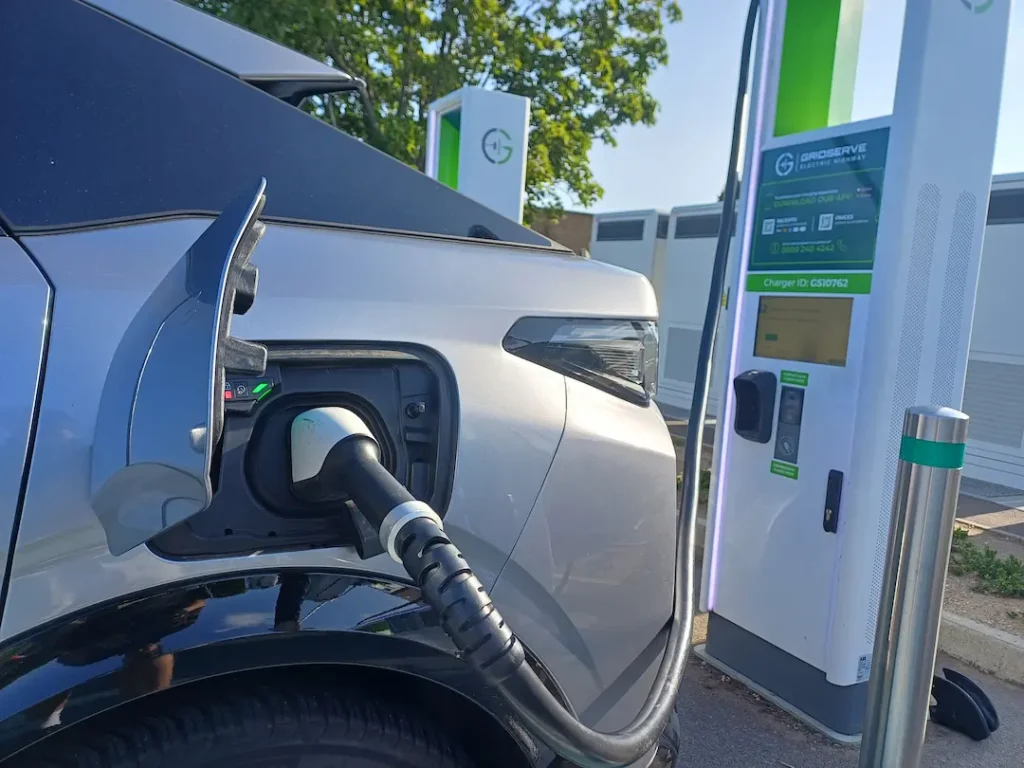
After similar 250-270 mile journeys, again, on a full battery, I found the Eco mode E-3008 to be between 85-90% accurate. That meant a discrepancy of only 30 miles or so per journey.
During my range testing, I found driving at around 55-60mph was a sweet spot for speed and efficiency, although I primarily tested this in Normal mode. It will be interesting to see how the E-3008 performs at those speeds, for extended periods, in Eco mode.
As with most EVs, the Peugeot E-3008’s efficiency is largely based on how you drive it. No big surprises there. There are certainly other EVs out there that will deliver more reliable range with less effort though. It will be interesting to test the Peugeot’s urban and city chops to see whether its predicted range is more on the money.
| Model | Peugeot E-3008 73kWh GT 210 |
| P11D price | £49,375 |
| As tested | £52,500 |
| Official WLTP range | 326 miles |
| Our average consumption | 4.1 miles/kWh |
| Mileage | 7,462 |
1st Report: Very electric, very French
I’ve grown so accustomed to driving electric cars that the electric elements – such as range and driving dynamics – don’t immediately enter into my mind anymore. Let’s be honest, the vast majority of new electric cars are pretty good, and they work so effectively that the once worrisome “will I run out of charge in the middle of nowhere” thought is a thing of the past.
Being a dad of two young kids, I’m more concerned with the practical, albeit mundane, elements of a car.
Regardless of family elements however, the first thing that struck me about the Peugeot E-3008 is the sheer amount of quirkiness that oozes from its design. Its exterior looks like a chiseled concept car, and its cabin – to quote my brother – looks like it belongs in a Lamborghini (a bit).
Peugeot has championed its i-Cockpit design for a while now, and it’s one of the few design languages out there that truly delivers in terms of sportiness. Everything in the cabin is strategically angled towards the driver, with fabric inlays sprinkled about to ensure all surfaces maintain a level of chicness.
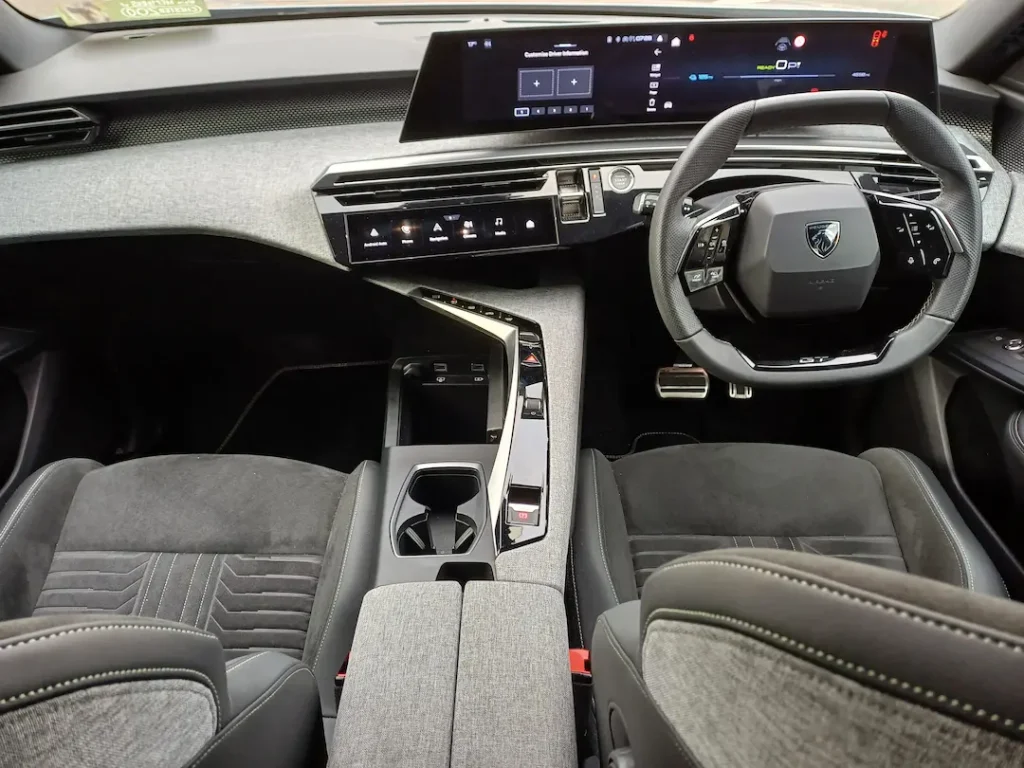
The large centre console is the linchpin of its athletic feel, splitting the cabin in two, with a strip of quick-access buttons running down the middle, a design element that helps give it that aforementioned Lambo feel. It’s a strange one, because you feel hemmed in behind its shrunken steering wheel, à la a hot hatch, and yet you sit quite high up – a best of both worlds scenario, if you ask me. The huge centre console makes for a cavernous amount of storage space too. In fact, you get two separate storage areas, one that sits under your arm, and another massive one that sits underneath the touchscreen, with the latter featuring a convenient folding cover for hiding valuables. The door bins are a good size too, easily swallowing a chunky one litre gym bottle.
Importantly, the cockpit-like cabin doesn’t have too many buttons and switches. Most functions are channeled through a swooping 21in display that covers half the dashboard, and a smaller shortcut panel that sits below it. I’m still getting used to the touchscreen system, but so far it’s been easy a pleasure to use. And the ability to customise the instrument cluster display is brilliant, with the maps readout being a particular favourite of mine. This system also comes with wireless Android Auto (and Apple Carplay), an absolute godsend when jumping in and out of the car with the kids.
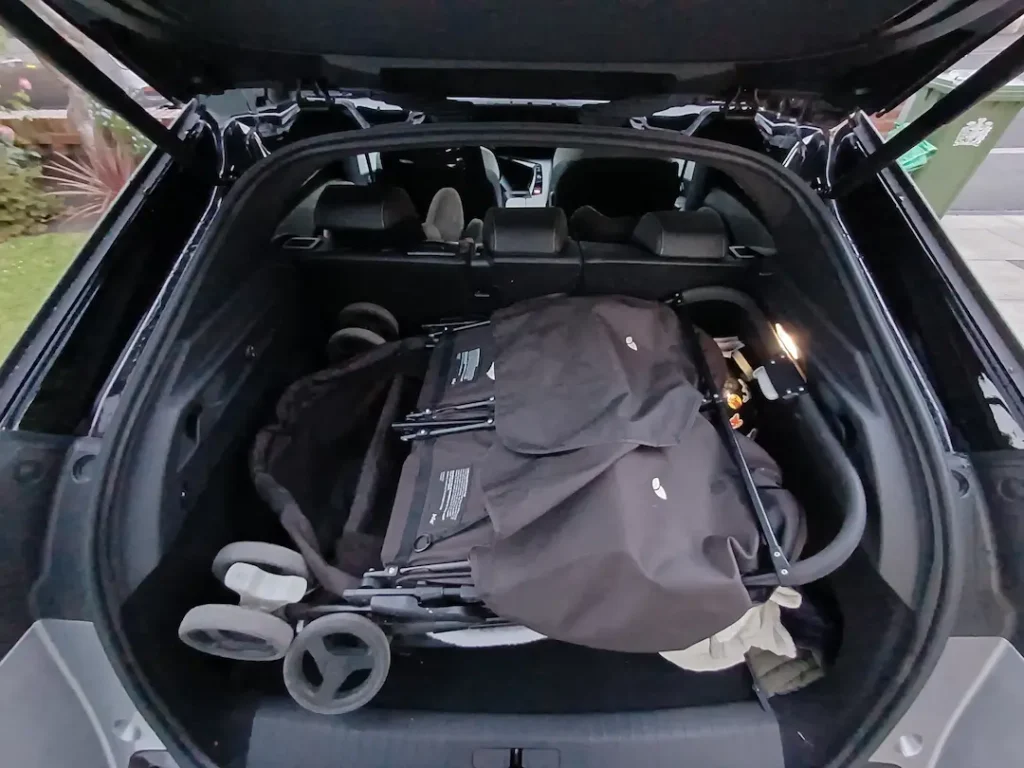
The boot size has impressed us on the E-3008. After coming off the back of having a Volvo EC40 for six months, we’d gotten used to pushing things over the back headrests to make them fit. But with 588 litres with the seats up, the E-3008 easily swallows our double pram lying flat – not an easy feat. The 1,662 litres on offer with the seats down has handled furniture removal tasks with ease as well. We’ve found the rear seats to be spacious as well. Even with two child seats fitted, our four-year-old has enough space to walk from one side of the car to another between the seats, thanks in part to the flat floor.
So far, the E-3008 has squashed any doubts I might have had regarding style over substance with the swanky-looking Peugeot. But with a chock-a-block month of long distance driving ahead, let’s see how it comes out the other end.
| Model | Peugeot E-3008 73kWh GT 210 |
| P11D price | £49,375 |
| As tested | £52,500 |
| Official WLTP range | 326 miles |
| Our average consumption | 4.5 miles/kWh |
| Mileage | 5,424 |
Standard equipment: Peugeot i-Cockpit 21in curved display, dual-zone climate control, wireless mirror screen (Apple Carplay and Android Auto), connected navigation, heated steering wheel, heated seats, adaptive cruise control, lane keeping assist, front and rear parking sensors, reversing camera, 20in Yosemite alloy wheels, LED exterior lighting.
Options: Metallic paint (£750), Advanced Grip Control (£300), heat pump (£700), 360 Vision and Drive Assist Pack (£600), tow bar (£500)