2nd Report: Driver (almost) not included
Cruise control is a mature technology. The term was first coined and marketed by Cadillac in 1960, just after the 1958 Chrysler Imperial used a similar tech, but the mechanical means to control engine speed has existed for centuries – James Watt and Matthew Boulton had ‘governors’ on their steam engines in 1788.
In modern cars, over the last quarter of a century, cruise control has slowly been upgraded to adaptive cruise control (ACC) which can maintain a safe distance from vehicles in front of your car using cameras, lasers and radar systems. But, as most of us have experienced, ACC is far from perfect. Too often it can lock on to different cars in a lurching manner to create the distinct impression to passengers that your right foot lacks subtlety, when really ‘the machine’ is the real culprit.
Consequently, I tend not to use ACC. But on the Elroq I’ve become a convert to its latest iteration called Predictive Adaptive Cruise Control (PACC). Its stated aims include: “Optimising energy consumption by automatically adapting the speed to the route, using data from the vehicle’s sensors. Bends, junctions and roundabouts are announced in good time. Speed Assist automatically follows speed limits based on Traffic Sign Recognition and when entering built-up areas.”
Which all sounds a bit dull and worthy, but the kit works brilliantly, especially in urban areas where speed limit changes and other road user variables are more prevalent. Case in point, the driver can set the cruise control to 20mph (when many existing ACC systems still aren’t calibrated to work below 30mph) so sticking to the often new and lower speed limits in English inner cities and lots of Wales is much easier. A simple press of the end of the lower stalk on the left-hand side of the steering wheel column sets the speed to the nearest number to the one you’re driving at already, while a nudge up or down adjusts it by 5mph or even 1mph, depending on how quick or fast you’re travelling.
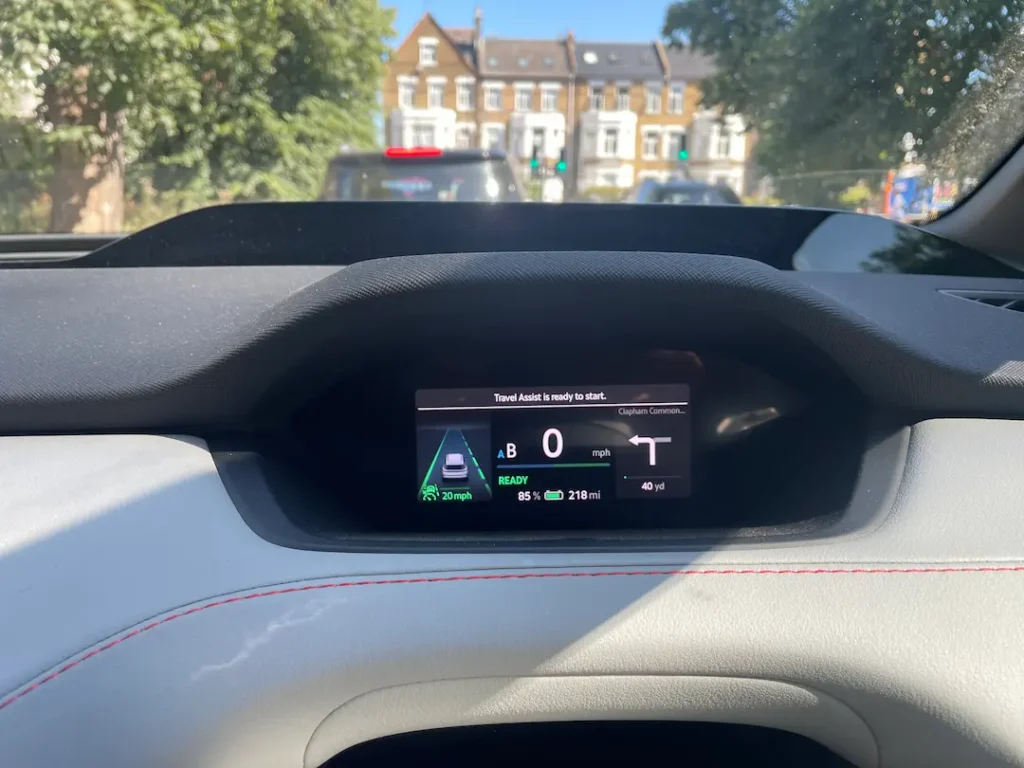
This is really helpful for 20mph speed cameras too. In PACC mode your car tends to sail through slightly faster than other vehicles in traffic without the system, as humans in charge often go slightly faster than the limit and then slam on the anchors to below the limit after spying the dreaded yellow box atop its pole. Better still, as the ‘P’ in PACC stands for ‘predictive’, the system also recognises speed limit changes. So, when a 20mph zone becomes 30mph the Elroq will automatically speed up to the new limit but also slow down for roundabouts, bends and other potential hazards.
In stop-start traffic it can even bring the car to a complete standstill and then accelerate up to the limit again without the driver pressing the accelerator, which takes a lot of the tedium out of such driving. Yes, Mercedes had similar tech with its Distronic Plus a while back, but Skoda’s system feels more fine-tuned. Alongside Travel Assist Plus (which includes Emergency Assist, Lane Assist Plus with Narrow Lane Assist and Urban Evasive Steering Support), the two systems create a large safety net in which silly (and sometimes fine-able) mistakes can be mitigated or avoided.
It’s true that its sensors do sometimes see side-road speed limit signs and think they apply to the main road you’re on, sending the system temporarily into a tailspin. So the driver still has to pay attention, not compose emails, have a nap, or take their hands off the wheel. I might have tried the latter to see how well the Elroq steered by itself – which is pretty well except for roads where the markings were worn or not re-painted clearly after works – but if you leave your mitts off the tiller for too long, the car’s system will quite quickly channel its inner Busta Rhymes and ask you politely, via the driver display, to “Put Your Hands Where My Eyes Can See”. I still prefer to drive, more than not, but the maturity of this system is impressive and genuinely useful.
| Model | Skoda Elroq Edition 60 |
| P11D price | £34,395 |
| As tested | £39,880 |
| Official WLTP range | 265 miles |
| Our average consumption | 3.8 miles/kWh |
| Mileage | 3,706 |
1st Report: New face of Skoda
I’m even more excited about my second ever Skoda long-termer than my first and now departed Kodiaq, for a few initial reasons: the Elroq compact represents the rather smart new face of Skoda design so there’s lots to talk about on that front; and secondly it’s a full EV rather than a plug-in hybrid, which suits my life better and is simpler to ‘fill up’ and keep track of in terms of efficiency. Starting with the first reason, you know the Elroq’s designers have done a good job when a discerning friend and Audi driver enquires admiringly after your new Skoda in the car park. Indeed, from VW Group’s perspective, perhaps they’ve done too good a job, as the sister brands have traditionally occupied different parts of the market, Audi ‘premium’ and Skoda ‘mainstream’. But with Audi’s current design fussiness and Skoda’s increasing design presence putting that pecking order into jeopardy, the difference between the two brands is less clear.
That’s especially true of the Elroq, which represents the smart new face of Skoda and its ‘Modern Solid’ design philosophy. The car’s exterior visual character comes not from the larger matrix headlights lower down the vehicle’s front, but from a quartet of super-slim LED daylight running headlights on each side directly under the clamshell bonnet. With a gloss black ‘mask’ in-between, where previously a combustion engine car’s open grille would have been positioned (as in the outgoing Kodiaq), the combined effect is a smoother, more aerodynamic and visually coherent front end, devoid of chrome and able to successfully hide its safety sensors.
These key facial elements sit within simple but balanced overall proportions, a few well-placed creases and consistent surface treatment from front to back and topped off with a subtle body-coloured ‘SKODA’ word mark on the lower centre of the bonnet, replacing the previous ‘winged arrow’ badge. At 4,488mm long the Elroq sits firmly in the compact crossover segment between the Volvo EX40 (4,440mm) and Toyota C-HR+ (4,520mm). But making the most of its EV-only platform, the wheels have been pushed out to its edges, allowing room for three battery sizes in-between – 55kWh, 63kWh and 82kWh – good for 232, 265 and 360 miles of range respectively.
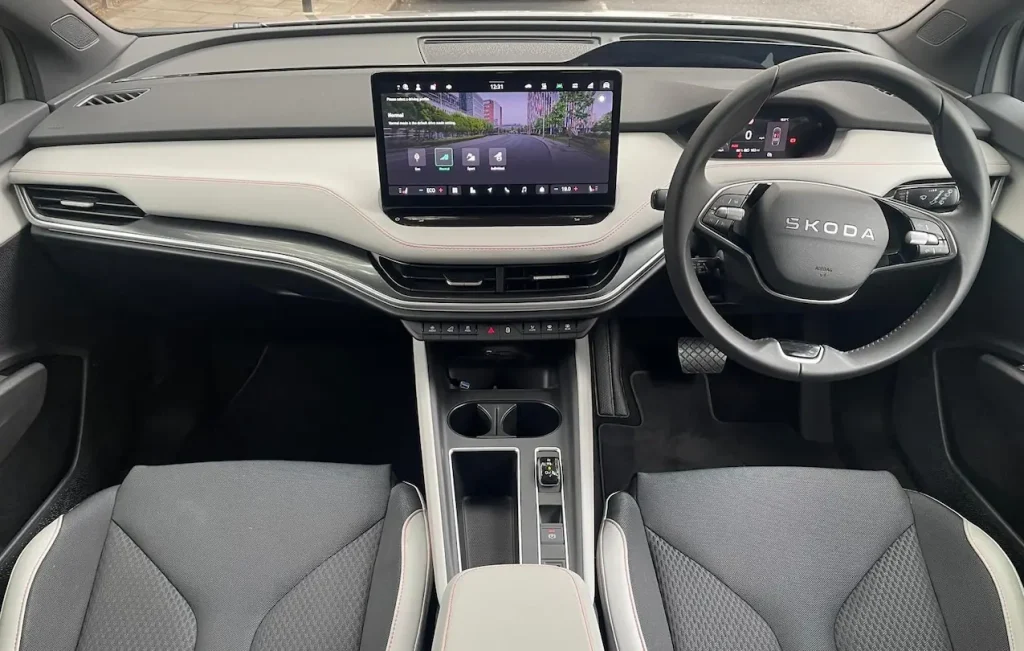
The interior of the Elroq also benefits from this longer (2,765mm) wheelbase through a spacious cabin with decent room for its class upfront and in the rear. The simple dashboard layout with its bulging middle allows for a good-sized 13in centre touchscreen plus eight physical switches beneath for key shortcuts, from driving assist to climate control. The gear selector on the centre console is a small and stubby affair, with an extra ‘B’ mode for extra brake regeneration. Four USB-C ports – two at the front and two at the rear – mean a typical family of four can plug in and easily pair phones to allow wireless Apple Carplay (or Android Auto).
The 470-1580-litre (min/max) boot space is good and crucially more flexible than most, courtesy of an array of nets, shelves and compartments that come as part of the Advanced Package fitted to this car. Costing £4,150, this pack also includes a driver head-up display, 360-degree bird’s eye parking view, ‘12+1’ speaker Canton sound system, electrically adjustable driver’s seat with massage function, and at the back, window blinds and a central storage area dividing the rear footwell.
The car’s 204hp all-electric, rear-wheel drive powertrain with a single-speed automatic gearbox is a doddle to drive smoothly and is aided by Travel Assist Plus and predictive adaptive cruise control which can bring the car to a full-stop or keep trundling along at 20mph in low-speed areas without stuttering. Driving EVs in summer always reaps efficiency benefits and this Elroq Edition 60 (with mid-range 63kWh battery) has recently beaten its official WLTP consumption figure of 3.9m/kWh, recording 4.3m/kWh on mixed roads. A promising start all round then.
| Model | Skoda Elroq Edition 60 |
| P11D price | £34,395 |
| As tested | £39,880 |
| Official WLTP range | 265 miles |
| Our average consumption | 4.3 miles/kWh |
| Mileage | 3,250 |
Standard equipment: Seven airbags, predictive adaptive cruise control with traffic jam assist, travel assist plus (including emergency and lane assist, plus urban evasive steering support), traffic sign recognition, LED headlights, front and rear parking sensors, keyless entry and start/stop, drive mode select, dual-zone climate control, heated front seats and steering wheel, 13in central touchscreen with satnav, rear view camera, DAB radio, Bluetooth, wireless Apple Carplay and Android Auto smartphone integration, two wireless smartphone charging slots, four USB-C ports (x2 front, x2 rear), power tailgate, electric folding door mirrors and puddle light, 19in wheels, in-door umbrella.
Options: Meteor Grey paint (£680), Design Selection Package – Lodge (£600), Advanced Package (£4,150)