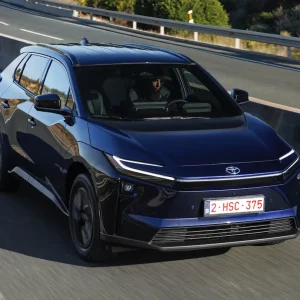
The BZ4X, Toyota’s first dedicated battery electric SUV, was launched in 2022, and quickly established itself as a practical, comfortable, and refined EV. It was a sales success, with more than 150,000 sold in Europe alone. However, the first-generation versions weren’t that efficient, and the charging speed was behind rivals, which offered a more convincing range.
Three years later, we have this comprehensively overhauled second-generation version of the BZ4X, according to customer feedback. This BZ4X has received a comprehensively revised BEV powertrain, which offers more power, greater efficiency, improved range, and quicker charge times.
Changes to the powertrain start with new 57.7kWh and 73.1kWh batteries, using a new design which Toyota says fits more cells into the same size battery pack. As a result, the range for the 57.7kWh battery is 276 miles. Ranges with the 73.1kWh pack are 354 miles for FWD versions and 320 miles for the AWD (All-Wheel Drive) version.
Maximum power output for the front and rear motors is also up, with the front increasing from 201hp to 224hp, and the rear from 107hp to 116hp.
There are also new compact, lightweight e-axles, that are engineered to minimise internal energy losses. They are also more powerful and energy efficient, thanks to the use of new silicon carbide semiconductors.
Alongside more range, charging times have been made quicker for the BZ4X. The maximum DC charging rate is now 150kW, with a charge from 10% to 80% taking just 28 minutes. Pre-conditioning of the battery can be operated manually, or it will engage automatically when a fast-charging point is programmed as a destination. High-grade models will also benefit from a new 22kW AC on-board charger.
With all these changes, the 57.7kWh battery powered BZ4X has 167hp, and an 8.6 second 0-62mph figure. Next up is the front-wheel drive 73.1kWh version, that is expected to appeal most to fleets. It has 224hp, and a 7.4 second 0-62mph acceleration figure. Lastly, there’s the range-topping all-wheel drive 73.1kWh version, with 343hp, and a 0-62mph acceleration time of 5.1 seconds.
Design and interior
Outside, the BZ4X’s exterior is sharpened up with the family ‘hammerhead’ front design, which consists of slimmer headlight units linked by a central light bar. At the side, the wheelarch trims are now finished in gloss black, along with new aero-efficient 18in and 20in alloy wheel designs. Then, at the back of the BZ4X, there’s a new diffuser and spoiler, to bring the co-efficient figure down from 0.29 to a slicker 0.27.
Inside, the BZ4X gets a new, slim, horizontally designed dashboard, with a new 14in infotainment screen in the centre on all versions. Toyota now calls the tall centre console a ‘digital island’, with two wireless smartphone chargers as standard. Other changes include a bigger panoramic roof, and new interior trim options made from recycled plastics.
The infotainment works as in other Toyota models before, with simple screen menus, featuring wireless Apple connectivity, but it seemed slow to respond, making inputs frustrating on the move! Elsewhere, the switchgear is familiar, and easy to operate.
All BZ4X models we tried had a comfortable driving position, with supportive seats, although the Peugeot i-Cockpit-style driving position won’t suit all. With the glass roof, the interior feels airy. The quality too, with soft-touch plastics on the doors, fabric inserts on the dashboard, and gloss black trim across the centre console, is generally impressive – although rivals such as the Kia EV6 and the Skoda Enyaq feel more special inside. Rear legroom also impresses, although the curvy roofline affects rear headroom. Plus, the 452-litre boot is practically shaped – it can be extended to 1,820 litres with the rear seats folded.
Performance and drive
We got the chance to drive two versions of the updated BZ4X – the front-wheel drive and all-wheel drive models with the 73.1kWh battery, both specced closest to the UK range-topping Excel grade (Toyota expects the mid-range Design grade to be the best-seller in fleet). We drove the most powerful, all-wheel drive version first – on and off-road. The BZ4X is closely related to the Subaru Solterra, and Toyota told us Subaru was responsible for the four-wheel drive systems, which proved impressively capable off-road. It is as good to drive as much on it as we remember, with precise steering, tight handling, and – as expected – high levels of grip. Although, you do feel the weight of the extra motor, and the low-speed ride is more unsettled.
We spent most of our driving time in the front-wheel drive version, which is expected to be most popular with UK fleet and retail buyers. Driving impressions are largely the same as the all-wheel drive version – but it feels lighter on its wheels, which makes the drive even better in our opinion.
Question marks remain about the range, although all the BZ4Xs that we drove seemed much more efficient than before. Prices have also been lowered when compared with the pre-facelift car. We have yet to try the BZ4X in the UK, but on this evidence, Toyota’s updated electric SUV is now a real contender, and can almost go wheel to wheel with key rivals.
Positive: Competitive pricing, good to drive, AWD version capable off-road, impressive interior space, seems efficient.
Negative: Still questions marks over the range, not the fastest to charge, driving position won’t suit all.
Standard equipment: 18in wheels, 14in Toyota Smart Connect+ multimedia system with wireless Apple Carplay and connect cloud navigation.
Engines: Electric: 167hp, 224hp, 343hp
Equipment grades: Icon, Design, Excel
Transmission: Single-speed automatic
| Model | Toyota BZ4X 73.1kWh Design FWD |
| P11D | £42,945 |
| Residual value | TBC |
| Depreciation | TBC |
| Fuel | £3,205 |
| Service, maintenance and repair | £2,577 |
| Cost per mile | TBC |
| Range | 354 miles |
| CO2 (BIK%) | 0g/km (3%) |
| BIK 20/40% a month | £22/£43 |
| Luggage capacity | 452 litres |
| Battery size/power | 73.1kWh/224hp |
| Score | 8/10 |