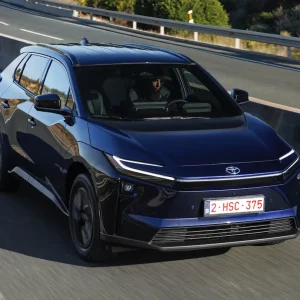
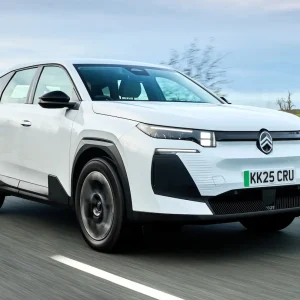
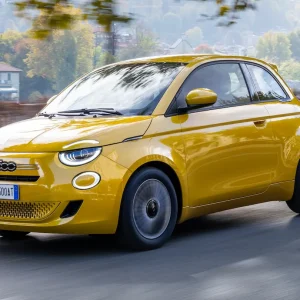
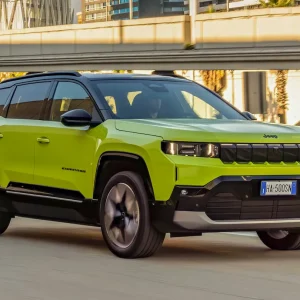
When the new Frontera was announced last year, the main headline from Vauxhall was that EV versions would be priced the same as ICE cars. Since then, the news from an electric perspective has only got better, as due to a price increase applied to petrol mild hybrid versions the Electric is now the cheapest Frontera available. What’s more, with a starting P11D of £23,930 (£27,130 with the range-topping Ultimate equipment grade tested here), not including the UK Government’s £1,500 Electric Car Grant for which it is eligible, it also comes in cheaper than similarly-sized electric SUV alternatives, at around £3,500 less than the cheapest Jaecoo E5, and around £8,500 less than the cheapest Hyundai Kona Electric. However, the Vauxhall is slightly more expensive than the closely related Citroen E-C3 Aircross.
Performance and drive
If you’re wondering what the catch is with this pricing, the most obvious compromise with the Frontera Electric (and the E-C3 Aircross) is the powertrain itself, which in entry-level form features a 113hp motor and a 44kWh battery. This is a combination we’ve previously seen in other models from Vauxhall and Citroen’s parent company Stellantis, but these have tended to be small cars, such as the Citroen E-C3 and Fiat Grande Panda. With the Frontera, it’s having to move a much bigger vehicle – at 4,385mm long just creeping into the smallest end of the C-SUV segment. This shows up in the Frontera Electric’s performance, where the usual rapid responsiveness of an EV is replaced by acceleration that’s actually quite ponderous from a standing start – although the motor acquits itself better at higher speeds. More importantly, the official WLTP range from that battery, at 186 miles with entry-level Fronteras (189 miles with the Ultimate grade), is well below the Jaecoo and Hyundai at 248 miles and 234 miles respectively. The Frontera Electric is also available with a 54kWh battery, which ups the range to 249-253 miles depending on spec, for an extra £3,500 – putting it on a par for price with the Jaecoo, and still cheaper than the Hyundai, although both of those models also boast more powerful motors.
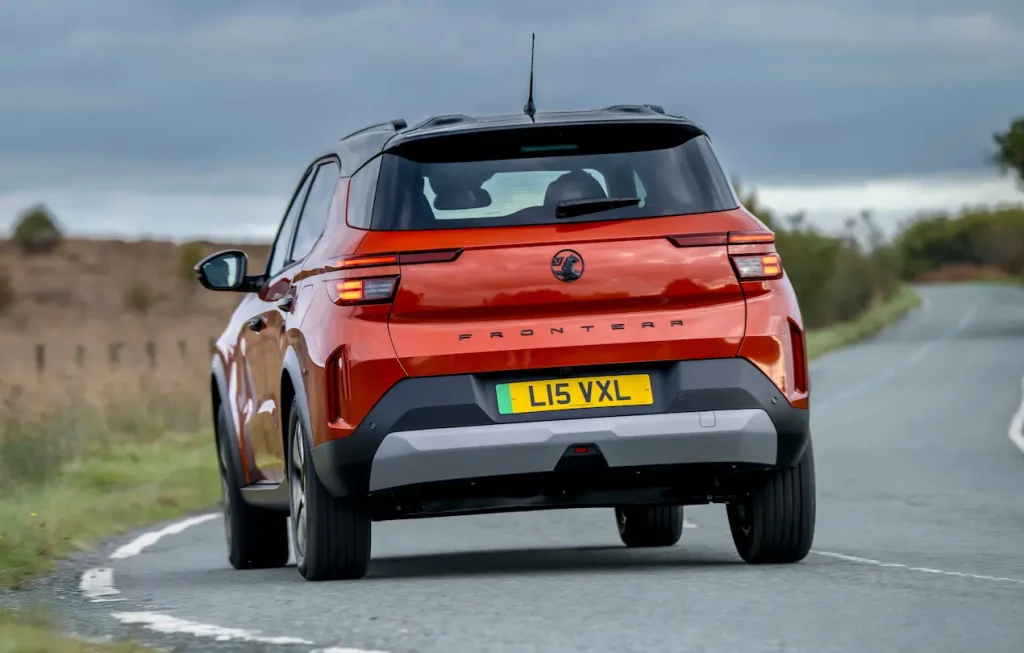
As for the rest of the driving experience, there’s an element of roll in corners, but the Frontera hangs on well, though it certainly isn’t sporty. Light steering is welcome around town, and precise enough to not cause issues at higher speeds. The ride is generally well composed, especially out of town, although an edge of firmness can come through when hitting manhole covers in urban areas. As for refinement, a fair bit of road noise is audible at motorway speeds.
Interior and technology
Vauxhall has introduced physical shortcut buttons to the right of the steering wheel, allowing the driver to easily switch off assistance systems such as audible speeding warnings. This is welcome – however, turning off the noise it makes when limits change requires going into a menu via the controls on the steering wheel. Strangely for an EV, the car is started using a traditional ignition key.
Despite being the range-topper, the Ultimate grade still features quite a bit of hard plastic trim – one of the clues to the model’s budget positioning, along with details like a very light central armrest/storage cubby lid. There’s the now familiar Vauxhall pair of 10in screens handling the driver display and infotainment, which work well and are nicely responsive. A useful hand-bracing shelf below the touchscreen makes it easier to operate on the move, while below this, thankfully, physical controls for the ventilation system are provided.

Despite the Frontera being at the smaller end of the family SUV segment (Vauxhall’s Grandland, at 4,650mm long, is positioned at the opposite end) rear leg and headroom is generous. There is a higher floor than with mild hybrid Fronteras, but the lateral space is sufficient that high-knee posture problems should be mitigated for all but the tallest. A 460-litre boot is the same as that with the mild hybrid.
Overall, the Frontera Electric makes a highly convincing proposition as a family EV for those on a budget. The battery range is the only major compromise – we suspect it will come down to individual drivers’ requirements whether that is justified by the P11D saving.
Positive: Attractive pricing, emphasis on physical controls.
Negative: Limited battery range, lots of plastic trim.
Standard equipment: Automatic Intelli-LED headlights with high beam assist, air conditioning, 10in digital instrument cluster, 10in touchscreen with connected sat-nav, wireless Apple Carplay and Android Auto connectivity, wireless smartphone charging, four USB ports, rear parking sensors, reversing camera, cruise control with speed limiter, automatic emergency braking, lane keep assist, driver drowsiness alert, speed sign recognition.
Engines: Petrol mild hybrid: 110hp 1.2, 145hp 1.2; Electric: 113hp
Equipment grades: Design, GS, Ultimate
Transmissions: Six-speed automatic, single-speed automatic
| Model | Vauxhall Frontera Electric 44kWh Ultimate |
| P11D (excluding Electric Car Grant): | £27,130 |
| Residual value | TBC |
| Depreciation | TBC |
| Fuel | £3,594 |
| Service, maintenance and repair | TBC |
| Cost per mile | TBC |
| Range | 189 miles |
| CO2 (BIK%) | 0g/km (3%) |
| BIK 20/40% a month | £14/£27 |
| Luggage capacity | 460 litres |
| Battery size/power | 44kWh/113hp |
| Score | 8/10 |