Since its launch earlier this year, sales of Skoda’s second EV, the Elroq, have got off to a flying start, with over 15,000 sold in the UK. Plus, it was Europe’s best-selling EV in April. So, Skoda must be hoping for more of the same sales success with the launch of the performance range-topper, the vRS. Especially as the UK is the second biggest market for vRS models.
Design and interior
The first-generation Enyaq vRS gave us a clue where Skoda’s performance sub brand was heading with electrification. But, after iconic vRS models of the past, we think fans are going to be disappointed with the Elroq’s rather subdued look. Firstly, vRS badging is limited to the front wings. Secondly, despite new bumpers, the vRS-only Mamba Green paint, different alloy wheel designs, and in our opinion, too much black detailing, it looks largely the same as the standard car.
It feels like Skoda has made more of an effort with the Elroq vRS’s interior. The design of the standard Elroq’s interior is attractive, and feels well-made, with the vRS adding green stitching to the luxurious-feeling microsuede, and artificial leather, that’s fitted throughout and is called the ‘Lounge’ set up. The driving position is good, and improved by the fitment of supportive, one-piece sports seats.
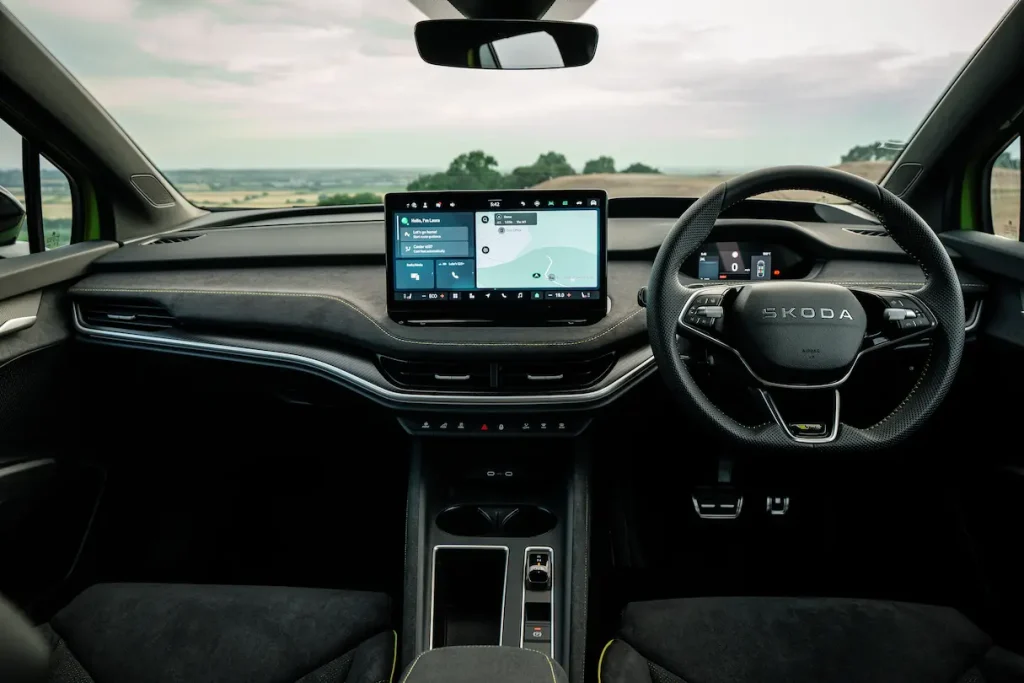
The 13in infotainment screen is as seen with the standard Elroq, and other Volkswagen Group products – it works well and is easy to connect your phone to. The Elroq is spacious in the back, with plenty of headroom, but because of the battery placement, your knees are higher than you might expect. The practical, spacious 470-litre boot has ‘Simply Clever’ design touches, such as a net underneath the parcel shelf for cables – why has no one come up with this solution before?
Performance and drive
The Elroq VRS is fitted with a larger 84kWh battery (79kWh net), and dual motors, equalling 335hp, 545Nm of torque, and a 0-62mph acceleration in just 5.4 seconds – making this the fastest accelerating Skoda ever, and all at 3% BIK! Yet, this Elroq is still capable of a 339 mile range, and can be DC charged at up to 185kW, equalling a 10-80% charge in around 26 minutes – so despite its performance, long journeys should be possible. Sadly, a heat pump is still a £1,100 option!
On the road, there are five driving modes, but all of them feel largely similar in the Elroq vRS – apart from ‘Sport’ mode, which changes the steering and throttle weighting. Considering the vRS has well over 300hp, you almost expect more drama when pinning the throttle. Although you feel the front raise up slightly, it almost feels underpowered (but isn’t!), as even in ‘Sport’ mode, there’s no spectacle, as the throttle response is very linear. Maybe it’s the lack of any noise that takes away some of the drama?
The Elroq vRS does its best performance work in the mid-range, where it feels genuinely fast – making overtaking other traffic a breeze. But it doesn’t feel a massive step up over the 85 version in the Sportline equipment grade that we’ve already driven.
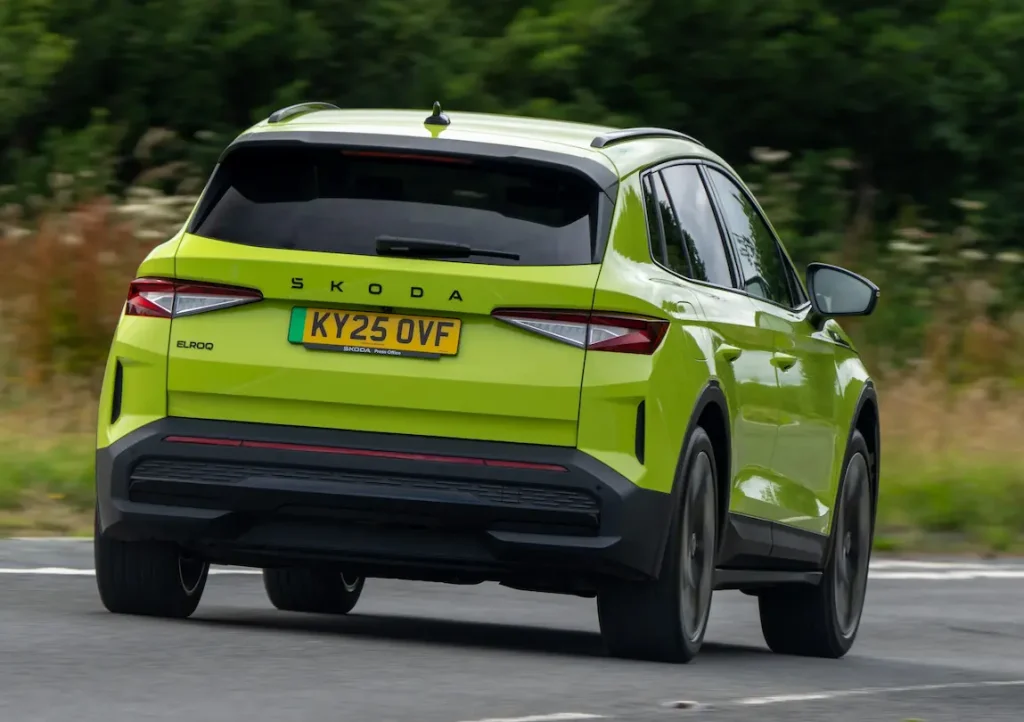
Along with the competent ride, which is largely the result of the standard fit Dynamic Chassis Control (DCC), with adaptive dampers, the Elroq vRS also has well-weighted, feelsome steering.
Considering the Elroq vRS’s specific suspension tune, the ride on the standard 20in alloys (21in alloys are an option!), is surprisingly and composed. The Elroq vRS handles well too but is best described as tidy rather than involving.
Like with the drive modes, there are several regenerative braking settings, although the car generally defaults to the adaptive mode – which can be annoying. Compared with Volkswagen Group rivals, brake feel is generally good.
The vRS is a faster version of the already brilliant Elroq, but here’s the problem, as in terms of the looks and drive, and given the £4,950 premium over the 85 Sportline, we’re not convinced the vRS is a better choice.
Positive: Spacious and practical interior, clean exterior design, efficient, refined ride, well-weighted steering, good brake feel.
Negative: Should look more special, heat pump an option, expensive, could it be more involving to drive?
Standard equipment: 20in Proteus silver alloy wheels, LED headlights and rear lights,13in touchscreen display, digital cockpit, single-zone climate control, rear-view camera with rear parking sensors, traffic sign recognition, blind spot detection.
Engines: Electric: 168hp, 201hp, 282hp
Equipment grades: SE, SE L, Edition, Sportline, vRS
Transmission: Single-speed automatic
| Model | Skoda Elroq vRS |
| P11D | £46,560 |
| Residual value | 46.8% |
| Depreciation | £24,758 |
| Fuel | £3,600 |
| Service, maintenance and repair | £3,362 |
| Cost per mile | 52.86p |
| Range | 339 miles |
| CO2 (BIK%) | 0g/km (3%) |
| BIK 20/40% a month | £23/£47 |
| Luggage capacity | 470 litres |
| Battery size/power | 84kWh/335hp |
| Score | 8/10 |