As we found out at the launch of the latest third-generation Duster, Dacia has sold a massive 2.2 million examples of that model since its launch in 2010. Now the brand has gone further, stretching the platform to create a medium SUV, called the Bigster, that we have here. The question is whether this high-value upstart can upset C-segment rivals such as the Ford Kuga and Kia Sportage.
Design and interior
Like the third-generation Duster, the Bigster again demonstrates the new distinctive, but attractive Dacia family look. Bigster design highlights include the vertical face with the distinctive grille and badging, the wide wheel arches with their chunky plastic trims, and the vertical details on the front doors. The Bigster is 23cm longer and 6cm taller than the Duster, with the extra length most noticeable around the rear, with the lengthened rear doors and quarters, that lead into the triangular rear lights. To sum up, the Bigster doesn’t look like a cheap, last-generation Renault like some earlier Dacia models.
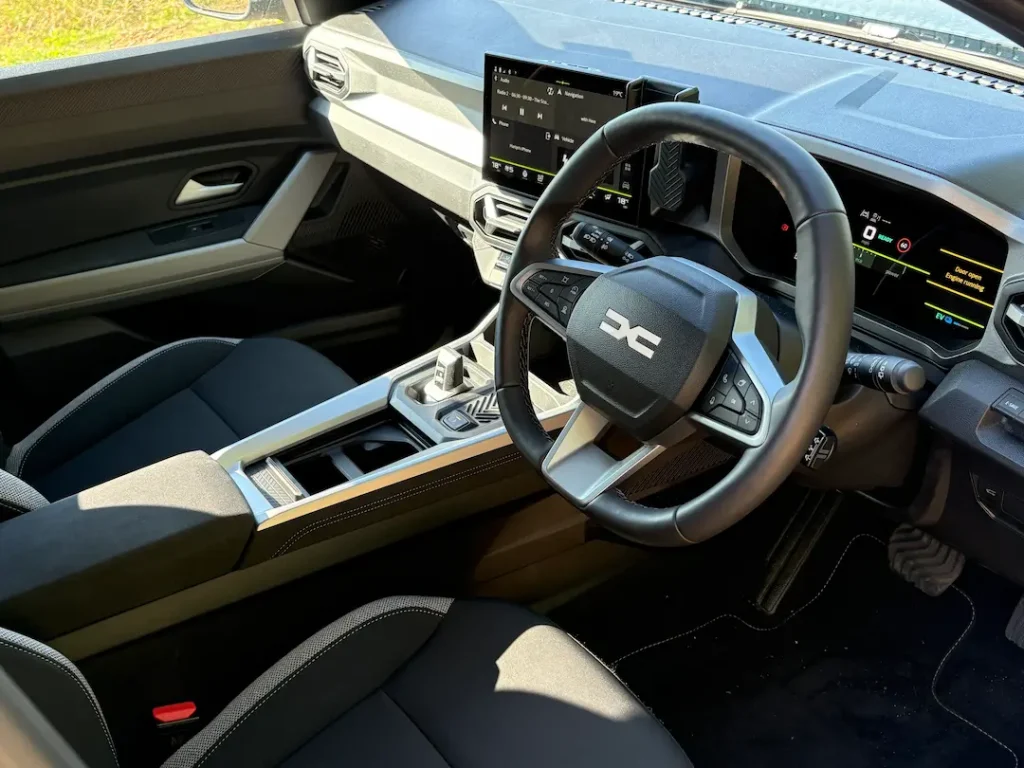
Inside, just like the Duster, the Bigster’s horizontally-styled dashboard is dominated by the 10.1in touchscreen, and heavily stylised air vents. It looks modern and sharp, with different textures and colours in the design – it’s just a shame the plastics are so hard, shiny and scratchy, living up to Dacia’s budget stereotype. In the front, the driving position seems taller and more upright than the Duster, but still comfortable.
As mentioned before, infotainment is via the 10.1in central touchscreen. It is a basic system, with standard ‘Live’ traffic navigation, and we felt the screen could have been more responsive to the touch.
Rear space is where the Bigster scores over the Duster, as there’s plenty – just like the front. Boot space also grows to a very practical 612 litres – choose the mild hybrid version, and this grows to an even more impressive 667 litres!
Performance and drive
Like the Duster, the Bigster is built on the newer CMF-B platform that also underpins the latest Renault 5 E-Tech and Clio. However, where the Bigster differs mechanically is that it has more powerful drivetrains. As such, the entry-level version is powered by a mild hybrid 1.2-litre three-cylinder petrol engine, mated with a six-speed manual gearbox, with power up to 140hp from the 130hp in the Duster. However, should you choose four-wheel drive in your Bigster, it has the same power figure as the Duster.
We’ve got the E-Tech full hybrid 155 version, in Journey spec, with most of the features you’d need, which is effectively the same system previously seen in many Renault models. Here, the Bigster is fitted with 1.8-litre petrol engine, over the 1.6-litre in the Duster, plus a larger 1.4kWh battery, with a clutchless gearbox.
Starting in EV-like silence, unless the battery is totally depleted, the Bigster’s petrol engine smoothly and swiftly takes over as speed builds – or after a sharp jab of acceleration. With a 0-62mph acceleration figure of 9.1 seconds, this Dacia is an adequate performer. Generally refined, but heavy acceleration equals plenty of engine noise.
Bigger than the Duster, the Bigster’s engine has the same character. When it does cut in, at low speeds, it can drone. Then, if you accelerate hard, it gets noisy as the engine works harder – however there’s no difficulty believing the impressive 60.1mpg combined consumption figure.
On the road, the Bigster’s steering lacks feel, but is still surprisingly precise. It is a tall car, and there’s some roll in corners, but there’s plenty of grip, and the ride is soft, comfortable and compliant at speed, on the 18in wheels our car had. Sadly, the ride on those wheels is harsher and more uncomfortable at low speeds.
A key hybrid SUV rival is the best-selling – and just facelifted – Kia Sportage. Even in entry-level Pure spec the Kia is over £3,600 more expensive and has a higher BIK figure of 30% versus 24%.
The new Duster is a desirable SUV itself; just think of the Bigster as its family SUV sister. It is not perfect, but there’s an overall likeable honesty to this Dacia – and it will take the brand in another exciting direction and build on previous sales success. It will certainly bring new conquest fleet customers to a brand they may not have considered before.
Positive: Sharp and attractive exterior and interior design, tidy and comfortable drive, Hybrid 155 model’s efficiency, decent boot and rear space.
Negative: Low-speed ride is unsettled, Hybrid 155 engines can be noisy and unrefined, interior plastics still look and feel cheap, unresponsive touchscreen.
Standard equipment: Media Control infotainment, fixed roof bars, six airbags, rear parking sensors.
Engines: Mild hybrid: 140hp 1.2, 130hp 1.2 (4×4); Hybrid: 155hp 1.8
Equipment grades: Expression, Journey, Extreme
Transmission: Six-speed dual clutch automatic
| Model | Dacia Bigster Journey Hybrid 155 |
| P11D | £29,295 |
| Residual value | 50% |
| Depreciation | £15,085 |
| Fuel | £5,075 |
| Service, maintenance and repair | £2,511 |
| Cost per mile | 37.78p |
| Fuel consumption | 60.1mpg |
| CO2 (BIK%) | 106g/km (27%) |
| BIK 20/40% a month | £132/£264 |
| Luggage capacity | 612 litres |
| Engine size/power | 1,793cc/155hp |
| Score | 7/10 |